Sunday, January 2, 2011
News From The Farm: Volume 1, Issue 4
Bok Choi Stir Fry Recipe
1 1/2 pounds bok choy or baby bok choy1 1/2 tablespoons canola, vegetable or peanut oil1-2 cloves garlic, finely minced1 teaspoon grated fresh ginger3 tablespoons broth or water (or 2 tablespoons broth/water + 1 tablespoon wine)salt to taste1/2 teaspoon sesame oil
1. Chop up the bok choy
2. Finely mince garlic and grate fresh ginger. Grating the ginger helps break up the tough fibers!
3. Place wok or frying pan on your stove and pour in the cooking oil. Add the garlic and ginger. Turn the heat to medium-high. Let the ginger and garlic gently sizzle in the oil. When the aromatics become fragrant and light golden brown, add the bok choy leaves. Toss very well to coat each leaf with the garlicky, gingery oil for 15 seconds. Pour in broth, water or wine. Immediately cover and let cook for 1 minute. Yummy!
News From The Farm: Volume 1, Issue 1
Country Delight Rhubarb Desert
2 cups rhubarb
1 cup flour
1/2 cup butter
1/3 cup confectioner’s sugar
3 eggs
1 1/2 cups sugar
1/4 cup flour
1 tsp baking powder
1 tsp vanilla
1/4 tsp salt
Blend flour and butter. Add confectioner’s sugar. Press into 9” square pan. Bake at 350 for 15 minutes.
Beat eggs, add 1 1/4 cup sugar very gradually. Beat until light and fluffy (5 minutes on high). Add flour, baking powder, vanilla and salt. Fold in rhubarb. Pour over crusts. Bake at 350 for 40 minutes until light brown.
Serve just the way it comes from the oven or with strawberries and whipped cream.
Wednesday, September 22, 2010
On the news!
09/22/2010 Redmond
From the farm to the kitchen, 28 year old farmer Sarahlee Lawrence is growing about 100 varieties of vegetables at her farm Rainshadow Organics. "This is my first year growing, and first year on this ground here and it's definitley very abundant, it's very exciting," said Lawrence.
For the past three months she's been supplying her produce to St. Charles in Redmond, now she's about to expand to St. Charles in Bend as well. "I'm excited to help people that are ailing and I think that food is so important," said Lawrence.
The hospital gets a load every week. "Whatever's fresh that's coming off of her farm is what we serve for lunch," said Benjamin Brown, Food Service Supervisor at St. Charles Redmond.
On the menu Wednesday, an organic buttercup squash and purple peruvian potato medly and mixed greens with steamed carrots all from rainshadow organics 16 miles away in terrebonne. " you know it's like chef's dream come true to be able to deal with vegetables that are that fresh," said Brown.
It's a dream come true for Lawrence as well. She plans to start expanding her two acres to 25 and start harvesting more vegetables by next year.
Monday, September 13, 2010
A column in today's local paper....
Area farm growing a new trend
By Lily Raff / The Bulletin
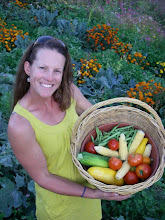
Sarahlee Lawrence
If I told you this column is about a Central Oregonian's first-ever farming season, you'd probably expect a sob story with dreams of a High Desert bounty crushed between a cold, late spring and an early autumn frost.
Spoiler alert: It's not.
Make no mistake, this is a success story, despite this summer's, well, challenging weather.
The farmer is Sarah- lee Lawrence, a 27-year-old who grew up on her parents' ranch near Terrebonne, left to study environmental science in college and graduate school, then worked as a river rafting guide for several years. She was teaching a course at the Wild Rockies Field Institute, in Colorado, when she came across some alarming curriculum materials about food. She learned, for example, that our food travels an average of 1,500 miles from the field to our plates.
“I just didn't realize that all these environmental issues existed with food,” she says. “I didn't realize that food is the biggest (part of our) carbon footprint and our biggest use of petroleum.”
Then she thought: “I could do something about that.”
Two years ago, she went home and planted cover crops to restore nutrients to the land where her parents had grown conventional hay. She shoveled 200 tons of manure onto the property to transform a three-acre patch of thin, volcanic soil into rich humus capable of prodducing vegetables.
Onlookers raised their eyebrows skeptically. Did she forget how cold it gets at night? There are other places where growing seasons are long and mild.
But Lawrence's reasoning was simple. “Why do we need to grow food here? Because we live here,” she says.
“Besides, it's not like we're tackling something impossible,” she adds. “It just takes more time and money than in some other places.”
She plowed ahead, naming her farm Rainshadow Organics, and turning to other farmers in Central Oregon for mentorship.
“They're skilled and super dedicated,” she says of local organic food growers, “and maybe a little crazy.”
Then she joined them. In early spring, she started seeds in the greenhouse.
She found an experienced helper, Michael Adcock, through a program called Willing Workers on Organic Farms.
In May, they began transplanting the sprouts into a one-acre plot they call the “baby garden,” where well water and a warm microclimate allow them to pamper delicate plants.
Meanwhile, word of her farm spread, especially in Sisters, which didn't have as many Community Supported Agriculture options as Bend and Redmond.
“People have been so, so enthusiastic,” she says. “I thought people would be supportive, but this ... blew me away.”
By late June, nearly 40 families had joined the CSA. They paid a flat fee at the start of the season in exchange for a weekly box of whatever produce she could provide. Lawrence is optimistic she'll find 60 members next year.
She also struck deals with St. Charles Redmond and several restaurants in Bend. Farmers markets, on the other hand, turned out to be an inefficient way to sell her goods.
All summer, to Lawrence's delight, food kept popping out of the ground.
“Everybody says, ‘You can't grow anything in Central Oregon.' Well, it turns out you can grow a lot,” she says.
From exotic-sounding green zebra tomatoes (in the greenhouse) and dragon-tongue beans to common spinach and onions, the farm did, in fact, produce a bounty, albeit for two short months.
Lawrence is getting close to winning the equivalent of the local farmers' lottery. She's in talks with St. Charles Bend to provide more produce to the hospital system next year, which could mean expanding by as many as 50 acres.
In other words, Lawrence isn't giving up her farming dream anytime soon.
“I love my job,” she says. “I hope I can do this until I'm, like, 100.”
Saturday, September 11, 2010
Some Recipes from CSA members
yield: Makes 6 first-course servings
ingredients
- 3 cups shelled fresh fava beans or frozen lima beans, thawed
- 2 cups coarsely chopped fresh basil
- 2 large garlic cloves, chopped
- 1/4 cup olive oil (preferably extra-virgin)
- 2 tablespoons fresh lemon juice
- 12 ounces tagliatelle or fettuccine
- 1/3 cup freshly grated pecorino Romano cheese
Cook beans in large pot of boiling salted water until crisp-tender, about 3 minutes. Using slotted spoon, transfer beans to large bowl. Reserve water in pot.
Combine 2 cups beans, 1 cup chopped basil and garlic in processor. Using on/off turns, process until beans are coarsely chopped. Transfer mixture to bowl with whole beans. Add remaining 1 cup basil, olive oil and fresh lemon juice. Stir to blend. Season bean mixture to taste with salt and pepper.
Meanwhile, cook pasta in same pot of boiling salted water until tender but still firm to bite. Drain pasta, reserving 1 cup cooking liquid. Return pasta to pot.
Stir 1/4 cup reserved cooking liquid into bean mixture. Add to pasta. Add 1/3 cup grated pecorino Romano cheese and enough remaining cooking liquid to moisten. Season pasta to taste with salt and pepper and serve.
I used large Zucchini instead of the winter squash.
2 tbl spoons olive oil
1 small onion finely chopped
2 cloves garlic minced
1/4 tsp thyme or 5 to 6 branches
1 bay leaf ( I left this out)
Salt
Heat the oil and add the above and cook over medium heat stirring often
until soft, then add.
1/2 tsp dry white wine Let the mixture reduce by half.
Add 1/4 tsp of Cayenne Pepper or 1/2 Paprika, I used both.
1 pound of tomatoes, fresh or canned, peeled, seeded and finely chopped,
Cook for 25 minutes stir occasionally until the sauce is thick.
Taste and add salt and a little sugar if needed.
Slice 4 oz of Fontina or Gruyere cheese.
Now time to prepare the squash. I cut the Zucchini in thick slices allowing
for two full lawyers in a 9x12 glass baking dish. They suggest hard squash,
removing hard skin, slicing 1/4 inch by 3 inch pieces.
Generously coat large fry pan and fry squash on both sides until brown and
slight tender, remove to towels and drain, then add salt and pepper.
Preheat oven 375 degrees, then spoon tomato sauce over bottom of baking
dish. Lay squash in overlapping layers with 4 oz of Fontina or Gruyere
cheese. I used what I had on hand, sharp cheddar and it was tasty.
Bake until cheese is melted and well heated through. 15 Minutes was fine
with the Zucchini, scatter fresh herbs over the surface.
Jean Kern
Wednesday, August 25, 2010
Cookin' it up!
Hi Sarah,
Just wanted you to know we took your mom’s advice and cooked the carrots. We cut them up, parboiled them, drained and put them on the grill with olive oil & seasoning. Oh my . . . they were delicious. Thank her for the tip!!!!
Joyce from Sisters
P.S. The seasoning we use is a new one from Penzeys Spices called Sunny Paris seasoning. It’s a combination of: purple shallots, chives, green peppercorn, French basil, French tarragon, chervil, bay leaf and dill weed.
Stephanie